
What’s Happening?
A Bundaberg-based LifeFlight crew has completed a difficult offshore rescue after an injured fisherman broke his leg on a trawler off the Rockhampton coast.
The mission was tasked by Retrieval Services Queensland at 8.37 am on Tuesday, 26 May.
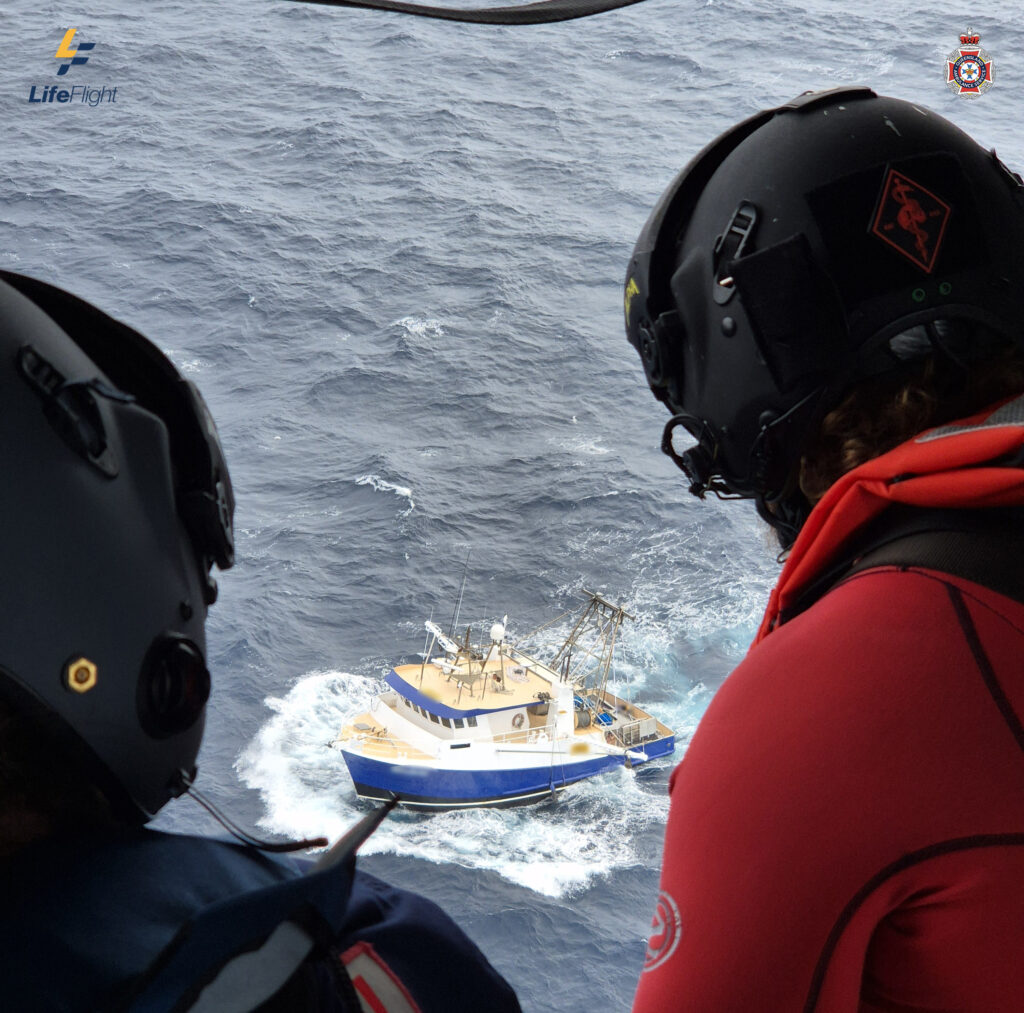
The rescue helicopter crew flew to the fishing vessel, where a LifeFlight rescue crew officer and a Queensland Ambulance Service flight critical care paramedic were winched onto the deck.
The medical team assessed and stabilised the man while working on the rolling trawler deck.
Rough ocean conditions meant the patient could not be winched up to the waiting helicopter.
The aircraft crew then landed nearby on Heron Island. The fisherman was safely moved to a smaller vessel and met the rescue team at the island.
He was later flown to LifeFlight’s Bundaberg base before QAS paramedics transported him to Bundaberg Hospital.
The man, aged in his 60s, was in a stable condition.
Why It Matters
The rescue shows how quickly medical emergencies at sea can become difficult for crews and patients.
It also shows the role of helicopter rescue teams in reaching people far from major hospitals.
LifeFlight Pilot Alex Dorr said the mission was the most challenging rescue of his career.
“It’s one of those jobs that you go ‘wow'”, he said.
“After 15-20 years in the game, it was absolutely a standout. They were very challenging conditions and challenging to get the crew on the back of the boat.”
By the Numbers
- The rescue took 13 hours, showing the scale of the offshore operation and the time needed to reach, treat and retrieve the patient.
- The trawler was about 110 nautical miles off the Rockhampton coast, placing the patient well beyond easy access to land-based care.
- The mission involved almost 950 kilometres of travel, with multiple refuels needed across the operation.
Local Impact
The incident was based off the Rockhampton coast, but the response drew on rescue resources from Bundaberg and support from QAS.
For fishing crews and maritime workers, the rescue is a reminder of the risks faced offshore.
It also highlights the importance of specialist retrieval services across regional Queensland, especially when patients are far from hospital care.
Zoom In
The most difficult part of the mission was getting the clinical crew safely onto the trawler.
The rescue crew had to winch medical staff onto a moving deck in rough seas.
Once on board, the team treated the injured fisherman while the vessel continued to roll in the ocean conditions.
The plan changed when the patient could not be safely winched back into the helicopter.
That decision led to the Heron Island transfer, where the patient was moved by smaller vessel before being flown to Bundaberg.
Zoom Out
The Bundaberg-based LifeFlight helicopter and crew service the Wide Bay-Burnett region and areas beyond it.
This mission shows how those crews can be called into offshore emergencies affecting people across the central Queensland coast.
It also shows how rescue work often depends on several agencies working together.
Retrieval Services Queensland tasked the mission, LifeFlight carried out the helicopter and winching operation, and QAS paramedics helped with patient care and transport.
What To Look For Next?
The fisherman’s stable condition is a positive outcome after a long and difficult rescue.
LifeFlight has also made winching vision and stills available, and a crew person is available for interviews, which may give more insight into how the mission was carried out.
