
What’s happening?
North West Island has been declared rat free after an intensive ground and aerial eradication program.
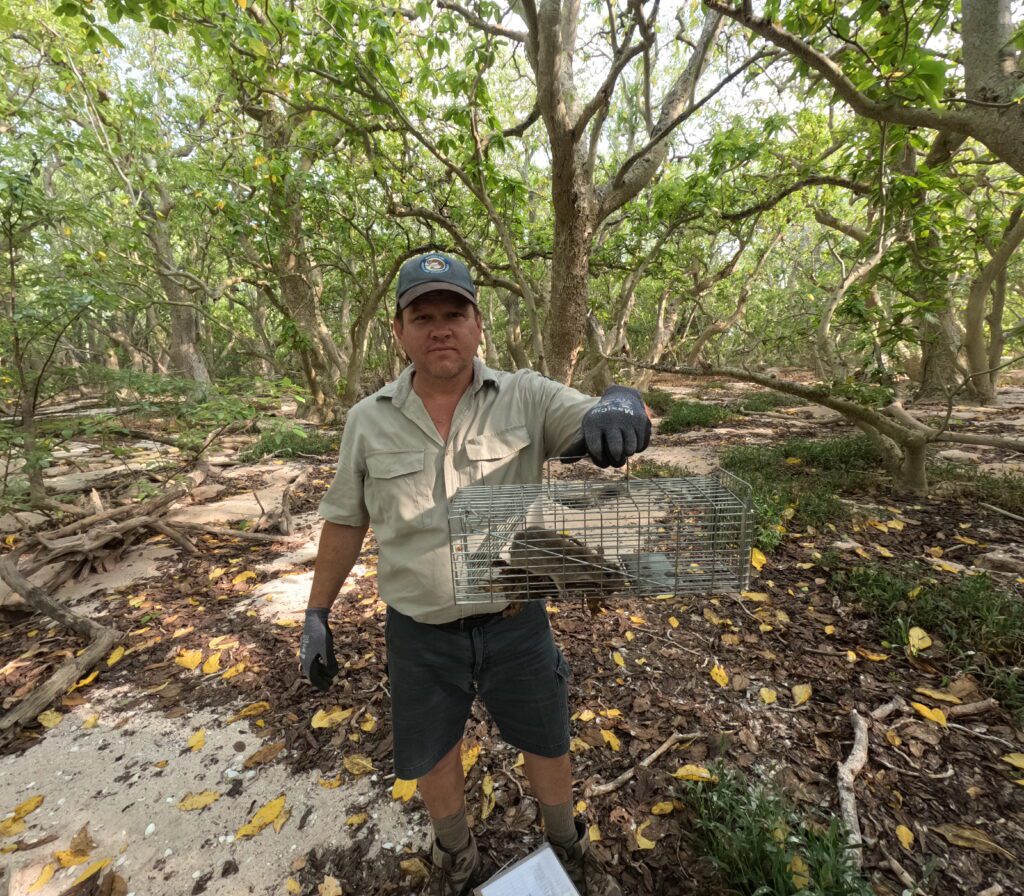
The invasive black rats were first reported to the Queensland Parks and Wildlife Service by campground hosts. Rangers then confirmed the presence of rats across the island using remote cameras and Black Trakka ink monitoring stations.
Because of the island’s environmental importance, the eradication project became a key priority for the Queensland Parks and Wildlife Service and the Gidarjil Land and Sea Rangers.
Senior Ranger Damon Shearer said the rats were most likely stowaways that arrived on boats or inside camping equipment brought to the island.
“The November 2022 confirmation that black rats had spread around the island was disappointing, because mice were declared as eradicated from the island just three months earlier,” Ranger Shearer said.
“Due to the size of the island, dropping aerial baits by helicopter was the most effective form of treatment, but we used bait stations and trapping to reduce the impacts on seabirds and turtles.
“The eradication program took 18 months, and the team frequently altered our tactics and adapted to the rats’ changing behaviour.
“After the eradication program was finished, we used remote cameras and Black Trakka traps to monitor for rats.
“Twelve months of intensive monitoring has shown no evidence of black rats, and rangers and Gidarjil Land and Sea Rangers are proud of the hard work that went into protecting the island.
“As the school holidays approach, we’re asking visitors to North West Island to check all equipment for rats and mice before departure and to arrive at the island pest free.”
Why it matters
Black rats pose a serious threat to island ecosystems.
They are omnivorous and will eat seabirds, eggs, chicks, vegetation, turtle eggs and hatchlings. This makes them a major danger to wildlife breeding areas.
North West Island is one of the Great Barrier Reef’s important nesting sites for seabirds and marine turtles, so protecting the island helps safeguard these species.
Local impact
North West Island sits within Capricornia Cays National Park in the Great Barrier Reef World Heritage Area.
Protecting the island helps preserve important wildlife habitat near the Central Queensland coast and supports ongoing conservation efforts in the region.
The work also highlights the role of rangers, Traditional Owner ranger groups and campground hosts in protecting reef island environments.
By the numbers
-
November 2022 marked the first confirmed report of black rats on North West Island after campground hosts alerted authorities.
-
The eradication program ran for 18 months as rangers adjusted their tactics to match changing rat behaviour.
-
Rangers completed 12 months of intensive monitoring after the eradication phase, with no signs of black rats detected.
-
North West Island lies about 75 kilometres north east of Gladstone within the Great Barrier Reef World Heritage Area.
Zoom in
Because of the island’s size, aerial baiting by helicopter was used as the primary treatment method.
Bait stations and trapping were also used to help reduce the impact on seabirds and turtles during the operation.
Monitoring tools such as remote cameras and Black Trakka traps were used after the eradication program to confirm the island was free from rats.
The project was delivered by the Reef Authority and Queensland Parks and Wildlife Service through the Reef Joint Field Management Program.
Funding came through the Australian Government’s Reef Trust, supported by Australia Pacific LNG, QGC and Santos GLNG.
Zoom out
Invasive species remain one of the biggest threats to island ecosystems across the Great Barrier Reef.
Rats can quickly establish large populations and damage important breeding areas for birds and marine turtles.
Early detection, coordinated response and long term monitoring are essential to protecting these fragile habitats.
What to look for next
Visitors heading to North West Island during the school holidays are being asked to carefully check boats, bags and camping gear before departure.
Authorities are encouraging travellers to arrive pest free to help keep the island protected.
Feral animals can be reported to the department by calling 13 74 68 or 13 QGOV.
