
What’s happening?
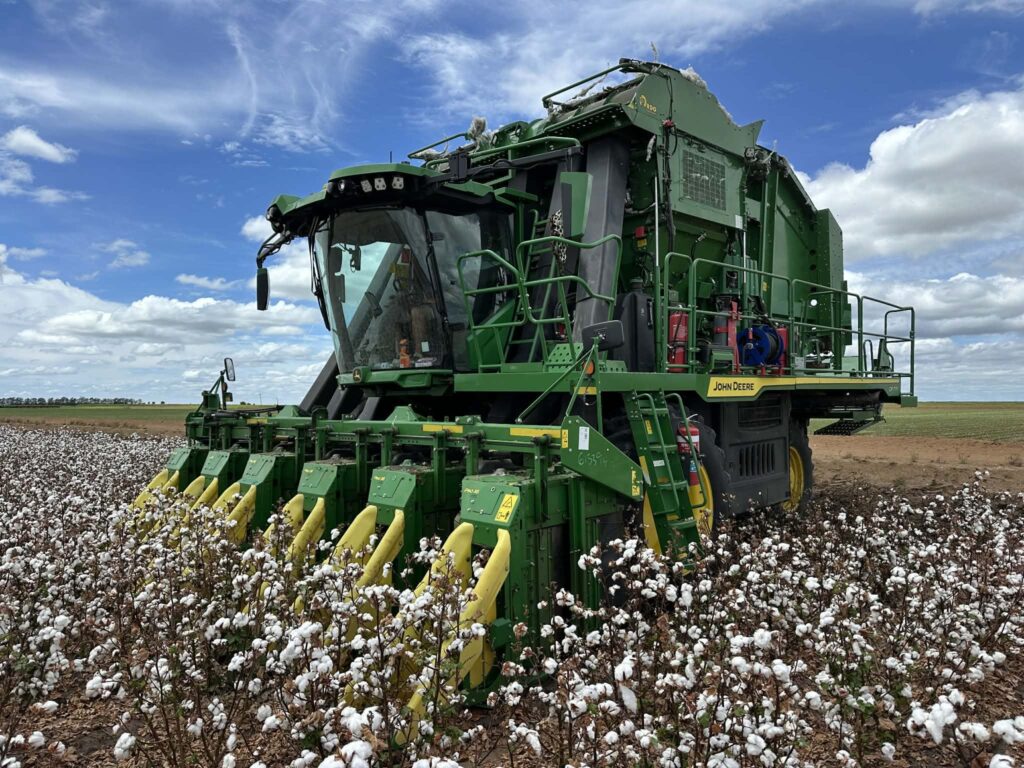
Cotton picking has begun in central Queensland, with Emerald growers Denis and Aaron Kiely first to start on Wednesday, 4 February.
They began harvesting their 71-hectare crop after a mixed season.
“It’s definitely nice to have the picker in the field, we were certainly lucky to miss storm activity the night before,” Aaron said.
“It’s picking very clean. Overall, I’m very happy with how it’s going so far, considering the variable season we’ve had with the weather. It’s rewarding to see the round bales in the field.”
While harvesting starts further west, growers in the Rockhampton region are preparing for their own picking window in May and June 2026.
Why it matters
Seasonal conditions have shaped cotton outlooks across Queensland and New South Wales.
Cotton Australia CEO Adam Kay said weather has been the key driver.
“Conditions have been mostly warm and favourable, but rainfall has been uneven,” Mr Kay said.
“Some valleys have received useful storm rain, while others have remained dry, with dryland crops particularly affected.
“Water availability is emerging as a constraint in parts of New South Wales, with some irrigated crops likely to be tight for final irrigations and dryland crops increasingly reliant on late rainfall.”
Despite this, the 2025-26 crop is predicted to produce around 4.4 million bales and generate more than 2.9 billion dollars for the Australian economy.
“This will flow back into the 249 rural and regional communities that directly benefit from the cotton industry, supporting local jobs and local economies,” Mr Kay said.
Local impact
In the Rockhampton region, including the Dawson and Callide Valleys, about 450 hectares of cotton have been planted.
Both irrigated and dryland cotton are in the ground.
Planting took place in November and December 2025, with picking expected in May and June 2026.
Renee Surawski, myBMP Regional Manager for the Rockhampton Region and Dawson and Callide Valleys, said it is too early to predict outcomes and yields.
Early crop growth and establishment have been positive, providing cautious optimism across the region.
She noted that the 2024-2025 season delivered strong yields in the Rockhampton region.
The 2025-2026 season will be difficult to surpass given last year’s favourable conditions and high retention.
However, there remains optimism that good yields can still be achieved this year.
As with all farming, results remain weather dependent.
By the numbers
-
Around 450 hectares have been planted across the Rockhampton region, including irrigated and dryland cotton.
-
Nationally, more than 450,000 green hectares of cotton have been planted this season, mainly in New South Wales and Queensland.
-
The 2025-26 crop is forecast to reach about 4.4 million bales and generate more than 2.9 billion dollars for the Australian economy.
Zoom in
The Kielys adjusted their water strategy after starting the season with zero water allocation.
“We had zero water allocation at the start of the season, we opted to pre-irrigate in June to fill the moisture profile in the field which enabled us to plant on the rainfall in early August,” Aaron said.
“We then spread our water scheduling out over five irrigation cycles. We will be interested to look at gross margins of this season’s crop.”
Recent rainfall lifted Central Highlands water allocations from zero to 89 per cent, allowing dropped hectares to restart flowering.
Zoom out
Across Australia, irrigated crops in northern NSW show strong retention, supported by reasonable dam levels.
Dryland crops face tighter finishes where rainfall has been missed.
Queensland crops are generally well advanced, with some areas slightly ahead of last season.
In Northern Australia, wet season conditions have created uncertainty with reduced planted area and variable establishment.
What to look for next?
Rockhampton growers will monitor weather closely ahead of May and June picking.
Final yields will depend on rainfall, heat events and water availability over the coming months.
