
What’s happening?
Applications for the 2026 Churchill Fellowships are now open, giving Australians the chance to travel overseas to research ideas that could benefit their communities.
The application round closes at 5pm on 30 April, with the Churchill Trust urging people not to delay preparing their submissions.
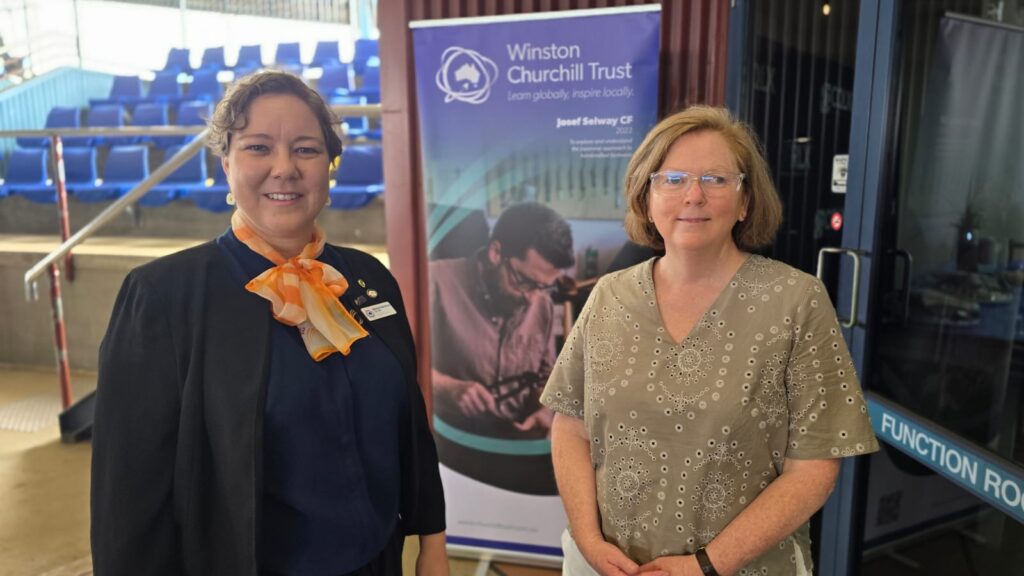
An information session was recently held at CQLX in Gracemere near Rockhampton, where locals were invited to learn more about the fellowship program.
Christine Dacey, Chief Executive Officer of the Churchill Trust of Australia, said the session aimed to explain how the fellowships work and encourage potential applicants.
“We’re doing an information session for the great people of Rockhampton to talk about the 2026 Fellowship Round,” Ms Dacey said.
“The good news is that the application round opened yesterday and we’ve already had a couple of very eager people submit their applications.”
Ms Dacey said the sessions allow people to ask questions and understand how their ideas could form a fellowship proposal.
“The information sessions are designed to give people the opportunity to ask all the questions that they want to ask and better understand what a fellowship is,” she said.
“We’re really pleased to be up here in Rockhampton for the first time.”
Why it matters
The Churchill Fellowship program funds Australians to travel overseas, investigate ideas and return with knowledge that can benefit communities, industries and organisations across the country.
Ms Dacey said the concept behind the fellowships is simple.
“So the Churchill Trust was established 60 years ago by Australians who generously donated money so that we could send Churchill Fellows overseas to learn about new things,” she said.
“And then the really big part of that is that when they come back, they do something to benefit others in their local community.”
She said the program focuses on service and community outcomes.
“That notion of service and doing something positive for your community is right at the DNA of our Fellowships,” Ms Dacey said.
“It’s about you going, learning, absorbing, observing, making new connections and then coming back and doing something for your community around you.”
Projects supported by the fellowship range widely across industries and interests.
“We have fellows who do everything from pirate ship restoration to hat making, to neurosurgery, to environmental science, to domestic violence, to berry growing, to whiskey distilling,” she said.
“You name it and we fund it.”
Local impact
Churchill Fellowships continue to influence Australian industries through research and global knowledge sharing.
One recent fellow is Melinda Hashimoto, Chief Executive Officer of Egg Farmers of Australia, who became a Churchill Fellow in September 2025.
Her fellowship allowed her to travel to Japan to study avian influenza of the H5 strain, a virus that can spread from birds to humans.
The strain has not been recorded in Australia, but Japan has experienced outbreaks and developed systems to manage the disease.
“I was keen to understand a little bit more about their biosecurity and the way they’ve been able to manage that to try and keep Australians safe and help our egg industry,” Ms Hashimoto said.
She said much of the early research on disease outbreaks focused on Western countries.
“So I think there was a lot of focus on certainly America and the UK and English-speaking countries when we were looking at disease outbreaks,” she said.
“I was really keen for us to look at what Asia’s doing. I think we can learn a great deal.”
Her research aimed to provide practical recommendations for Australian egg producers.
“My aim was to be able to bring back useful information and make recommendations that could actually be practically implemented by our farmers,” she said.
After completing her report, Ms Hashimoto began sharing the findings with industry leaders, government agencies and experts in food safety and biosecurity.
“It was very exciting to be able to share what I learnt with my industry, but the broader government and people who are experts in food safety and wild birds,” she said.
Her research also created international connections with farmers and researchers.
“I was contacted by a farmer in India who had read my report,” Ms Hashimoto said.
“I was able to understand more about what they’re doing over in India and ask some questions.”
She said the fellowship network itself has also become an important professional community.
“I’d never met a Churchill Fellow until I went to my interview,” she said.
“But now I have about 150 Churchill Fellow friends.”
“It’s really about learning globally and inspiring locally.”
By the numbers
-
Around 1,000 Australians apply each year for about 100 fellowships, highlighting how competitive the program has become.
-
Over 60 years the Churchill Trust has supported nearly 5,000 fellows, sending Australians overseas to study ideas and innovations.
-
A national fundraising effort in 1967 raised $2 million, which later grew into a $10 million fund through careful investment over six decades.
Ms Dacey said the fundraising effort followed the death of Sir Winston Churchill.
“That public fundraising effort after Sir Winston Churchill passed away remains to this day the single biggest public fundraising effort in Australia’s history,” she said.
“They raised so much money, and we have looked after and nurtured and invested that money over six decades.”
Zoom in
Among those attending the Rockhampton session was puppet builder Jacob Weegenaar, who hopes to apply for a fellowship to expand his creative skills.
“I make puppets, and I would love to go into different countries, into New Zealand,” Mr Weegenaar said.
He hopes to secure a residency at Weta Workshop in New Zealand, where he can learn more about advanced techniques.
“There’s a residency to learn more about the craft because there’s animatronics and sculptures that I haven’t really dabbled in yet,” he said.
“And I want to learn more so I can bring it back and benefit the community here.”
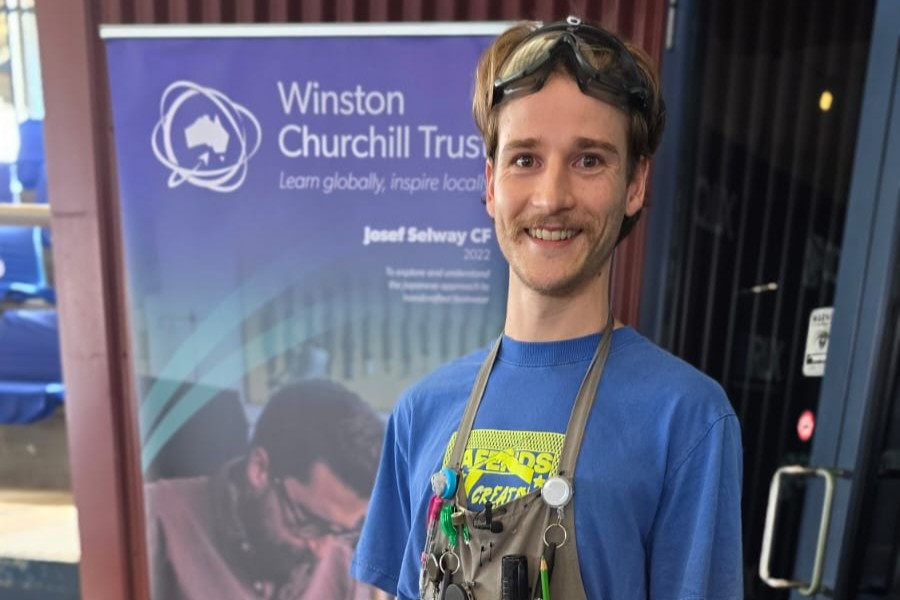
Mr Weegenaar said puppet-making is a rare profession in Australia.
“Probably less than 20 in Australia currently,” he said.
He began making puppets while working as a kindergarten teacher.
“I wanted to help find a way to engage with the kids,” he said.
“It started with a paper plate. Fold that in half and put two eyes on it and suddenly it was a frog.”
His work has since grown into a full-time creative career.
One of his largest creations is a shark puppet measuring 4.4 metres long, built using foam floor mats, tubing and bamboo supports.
Zoom out
Churchill Fellows have contributed to a wide range of projects and initiatives across Australia.
Ms Dacey said many everyday ideas and programs have links to Churchill Fellows.
“Fellows are everywhere. You can find them in plain sight,” she said.
“If you ever looked at the unit pricing in a supermarket shelf, that’s a Churchill fellow.”
“If you’ve ever been in Neighbourhood Watch, that’s a Churchill fellow.”
“If you’ve ever been to Questacon in Canberra, that’s a Churchill fellow.”
“Drip irrigation, that was a Churchill fellow.
What to look for next
Applications for the 2026 Churchill Fellowships remain open until 5 pm on 30 April.
Potential applicants can access recorded information sessions and application resources through the Churchill Trust website.
“We have a number of sessions recorded on our YouTube channel,” Ms Dacey said.
“There are frequently asked questions, a sample application, video and animations telling you everything that you might need to know.”
“I would really encourage people not to leave it to the last minute if you’re serious, because it’s a really competitive process.”
