

What’s happening?
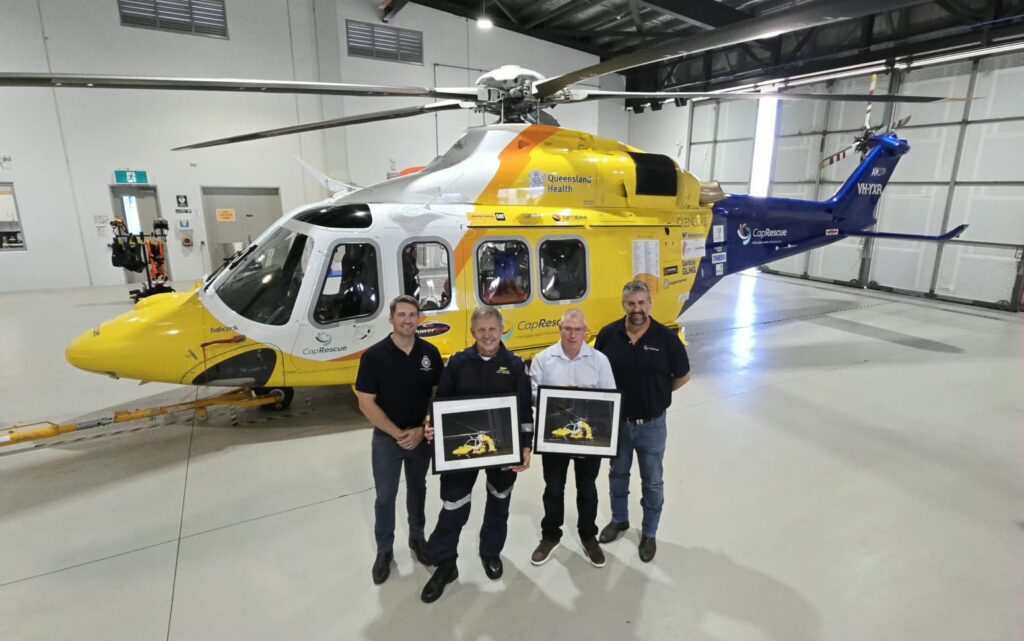
CapRescue has farewelled two veteran paramedics whose careers spanned multiple generations of emergency and aeromedical care across Central Queensland and beyond.
The farewell brought together pilots, doctors, air crew, rescue crew, peer paramedics and senior leaders, all gathering to recognise the contribution of two officers who served as critical care and flight paramedics.
CapRescue Chief Executive Officer Darren Peary said the occasion marked the loss of an extraordinary depth of experience within the service.
“Today we did a farewell for two amazing paramedics, critical care paramedics and flight paramedics for CapRescue,” Mr Peary said.
“It was good today, we got their officer-in-charge, their directors, their doctors, their peer paramedics, all the team here from CapRescue, the pilots, the air crew and rescue crew, just together to say thank you.”
Why it matters?
Both paramedics worked through some of the most significant transitions in Queensland’s emergency services, moving from road-based response to fixed-wing aircraft and eventually into modern helicopter operations.
Mr Peary said their careers reflected the steady advancement of the profession itself.
“They haven’t sat in their laurels and just become a name,” he said. “They wanted to advance themselves all the time.”
That approach, he said, helped shape the next generation of paramedics.
“They’ve been mentors their whole career,” Mr Peary said. “The amount of people they would have trained over the years, and the knowledge younger paramedics have soaked up, is enormous.”
Local impact
Both paramedics served communities across vast and often remote parts of Queensland, including mining sites, islands, coastal regions and the far west.
Mr Ferguson said helicopters were essential in regions where distance could otherwise cost lives.
“If we didn’t have that utility to get onto the site itself, a lot of people wouldn’t be saved and wouldn’t be here today,” he said.
Mr Peary said coordinated care has changed patient outcomes across the region.
“We bring critical care to the patient, then transition them to definitive care,” he said. “That might be Rockhampton or straight to Brisbane for specialist care.”
He said early communication with hospitals was central to that system.
“Through pre-notification, surgeons can be ready in emergency, ready to go straight to surgery,” Mr Peary said.
By the numbers
-
77 years of combined service, covering road, fixed wing and rotary wing emergency response across Queensland.
-
42 years of service by Jon Ferguson, who began as a volunteer in December 1983 and entered the service in 1984.
-
Thousands of lives impacted, with Mr Peary estimating that aeromedical and rotary wing services have saved or significantly improved outcomes for thousands of patients.
Zoom in
Jon Ferguson, Critical Care Flight Paramedic, traced his career back to a very different era of ambulance work.
“I started out as a volunteer back in December 1983,” he said. “I started in the service in 1984 and was appointed to the honorary staff at Rockhampton on the 11th of May, 1984.”
He said the expectations placed on paramedics at the time were a far cry from today’s standards.
“All I needed to become a paramedic back then was senior first aid, a bronze medallion in lifesaving, a home nursing certificate and a driver’s licence,” Mr Ferguson said.
“We were considered tradesmen’s assistants. We weren’t even considered a profession.”
Despite those limitations, he said the work quickly became more than a job.
“I already had an altruistic nature,” he said. “I was always the guy they called to do the first aid, and it just grew from there.”
Zoom out
Mr Peary said both officers experienced the full technological and operational shift of Queensland’s aeromedical services.
“They started from the Queensland Airmen’s Transport Brigade before 1990,” he said. “Then we became the Queensland Airmen’s Service, and the community-based helicopter groups started in 1996 in Mackay and Rockhampton.”
He said the change in aircraft alone told the story of progress.
“They’ve seen the transition from Long Rangers and Squirrels to what you see behind me now, a state-of-the-art AW139,” Mr Peary said.
Mr Ferguson said the real change was not just speed, but capability.
“A lot of what we do is bringing intensive care or critical care medicine to the scene,” he said. “We do things patients would normally have to wait to get to hospital for.”

What to look for next?
While stepping back from frontline duty, the legacy of both paramedics continues through the systems they helped build and the people they trained.
Mr Ferguson said the mindset he encouraged in younger paramedics remained simple.
“Start out the way you mean to carry on,” he said. “If you want to be a critical care paramedic, start thinking like one from day one.”
Reflecting on how he hoped to be remembered, he focused on people rather than roles.
“An advocate for the patient, an advocate for our people, and for better ways of doing business,” Mr Ferguson said.
“And at the same time, a bit of a goofball.”
“I’ve done 42 years,” he said. “But I’m still curious.”
